
 Free Estimate
 Financing
 Commercial Solutions
 Maintenance
 Bill Pay

Your Front Door Hasn’t Moved. Has the Porch?, in BEAVERTON
Have a sunken concrete porch in Beaverton? Learn what uneven steps, widening gaps, and pooling water can reveal and when concrete leveling may help.
You know the exact height of your front step—until your foot catches where it never used to.
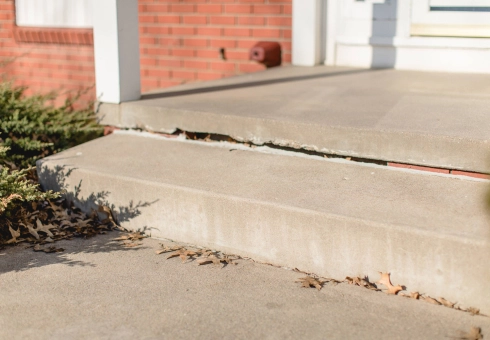
A sunken concrete porch can develop gradually, changing the transition between your walkway, landing, and front door. What first looks like a small gap may be a sign that the slab no longer has consistent support underneath.
For Beaverton homeowners, the useful question is not just how to make the entrance look better. It is why the concrete moved and which repair fits its condition.
The change may be small.
Your footing notices.
A sunken concrete porch does not always begin with a dramatic crack. One edge may settle while another stays in place, leaving an uneven step or a growing separation beside the house.
Take note of changes where different surfaces meet. A misaligned walkway, a tilted landing, or an unfamiliar step height can make an everyday entrance harder to navigate.
TerraFirma’s concrete leveling and repair solutions address slab settlement by evaluating the concrete and the support beneath it.
Three changes
worth noticing.
These observations can help you describe a sunken concrete porch during an inspection. They are clues, rather than a diagnosis.
An uneven approach
The walkway and landing no longer meet evenly, creating a raised edge along a frequently used path.
A changing gap
Separation beside the house or adjoining steps appears wider than before. Photos taken over time can help document the change.
Water collecting
Rainwater lingers in a low area or flows toward the entrance instead of draining away from it.
The surface tells a story.
The cause may be below.
Concrete depends on the material beneath it for support. Poorly compacted fill can settle, while water moving beneath a slab can wash away supporting soil. Changes in soil moisture may also contribute to movement.
A sunken concrete porch needs an assessment of both the slab and its surroundings. Nearby downspouts, drainage patterns, open joints, and the condition of adjacent concrete can help explain what is happening.
The porch also needs to be distinguished from the home’s structural foundation. Movement in a separate landing does not automatically mean the house is settling. If broader structural concerns are present, they may require a foundation repair assessment .
Can the existing
concrete stay?
A sunken concrete porch may be a candidate for lifting when the slab remains suitable for repair. Polyurethane foam injection can fill voids and raise appropriate sections of settled concrete.
Suitability depends on the slab’s condition, access, supporting materials, and how the porch connects to nearby structures. An inspection helps establish what can realistically be corrected.

Match the repair
to the condition.
Choosing a repair for a sunken concrete porch involves more than comparing surface appearance. The condition of the concrete and the reason for movement both matter.
When lifting may fit
A largely intact slab with settlement beneath it may be suitable for leveling. Appropriate crack and joint sealing may also help limit water entry through those openings.
When another approach is needed
Severely deteriorated concrete, extensive fragmentation, or structural complications may call for replacement or a different repair design.
A familiar entrance.
A change worth understanding.
Before covering a sunken concrete porch with a surface coating or replacing it outright, find out why it moved. Understanding the support beneath the slab helps you compare repair recommendations with confidence.
For a sunken concrete porch in Beaverton, useful inspection questions include whether lifting is appropriate, what may be contributing to settlement, and whether drainage needs attention alongside the concrete repair.
Learn more about TerraFirma’s concrete and foundation services in Beaverton to understand how different home concerns are evaluated.
TerraFirma Homeowner Resources
Why does concrete
crack, sink, or settle?
Cracked driveways, sinking patios, and uneven garage floors can point to problems beneath the surface. Watch TerraFirma explain how poorly compacted soil, dry conditions, flooding, and tree roots can contribute to concrete damage.
A closer look beneath the slab can help identify the cause and guide the right concrete repair approach.
CONCRETE REPAIR
HOMEOWNER QUESTIONS
How does the warranty work?
For concrete slabs raised with TerraFirma’s PolyLevel®, we guarantee that the area where the slab of concrete was lifted will not settle more than ¼ inch for a period of 5 years from the date of installation. If it does, we will provide the labor and materials to re-level the area at no additional charge.
What is better: mudjacking or polyurethane?
A Polyurethane solution is not as messy or disruptive as other foundation-lifting techniques like mudjacking. Our PolyLevel solution is lightweight (without compromising strength), offers faster installation and cure time, making it the best option available.
What kind of foam is used to lift concrete?
High-density polyurethane foam is the expert’s choice for concrete lift. Our PolyLevel solution uses a high-density polyurethane foam to fill voids and stabilize sinking concrete slabs. The expanding properties of the two-part urethane formula allows for the lifting of the slab.
Can you repair cracked concrete after going through concrete leveling?
Yes. In fact, we recommend that our TerraFirma Concrete Leveling customers seal the cracks and joints of their newly lifted concrete with our NexusPro solution, as it will help protect their concrete for many years to come.
My concrete seems to have settled over the winter. What should I do?
Your concrete most likely didn’t settle, but instead the adjacent concrete slabs heaved upwards, due to the frozen dirt below. There is nothing that can be done, but wait for the ground to thaw and the concrete to return to its original position. If the concrete doesn’t return to its normal position in the spring, you may want to have one of our experts take a look to determine if a permanent solution is necessary.


